A few times in the past I have pulled the ‘we’re not ready for…’ card, including when we wrote about deepfakes in education back in 2024 (see here and here). Largely, that has turned out to be true so far – but it has been perhaps less calamitous than I envisioned so far. In the UK, government and police action is taking place.
Here I go again. Wearable AI is about to pose some real problems, and largely, society has not begun thinking ahead. The window for action is closing quicker than with deepfakes.
There are three major issues I foresee:
1. Visual Recording and Facial Recognition
This is the main issue with the glasses I am wearing. They are hard to notice, as I have documented before. If you are unscrupulous, you can buy covers that hide the LED light that indicates that you’re recording. This means, you can just record at any time. Hands-free. I bought some to investigate/experiment, and pass around when I give talks or keynotes, alongside my other visual aids (Google Glass, Rabbit R1, and of course, my glasses). They cost less than £10, including delivery (Note: I would not use these, they are just for demonstration purposes – My post on ethics covers my ground rules for recording).
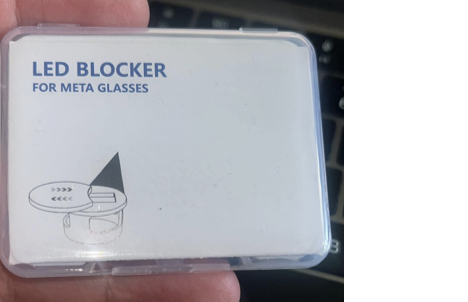
Think about how many sensitive areas there are in the world, where you would feel uncomfortable if you saw someone recording on a phone or another device. That visibility is important because people can a) tell them to stop, b) inform someone with authority to intervene, c) identify details about who it is recording.
Yes, spy cameras are available and have been for a while, but there is a distinct difference.
Spy cameras have never been a socially acceptable, commonly worn, everyday technology. They have never been something that you would walk into a high-street chain store and buy.
They have never been something that has melded with stylish, well-known fashion brands.
The point here is social acceptability and plausible deniability.
Someone caught wearing a spy camera will be treated very differently from someone who is wearing a fashion statement, that happens to record. They can explain it away, claim it was a mistake, an error, or that it’s not recording.
I don’t believe that there is enough awareness or information on the fact that these glasses record so well and so subtly.
Now let’s take this further, in light of events of the last few days.
It was reported last week that Meta embedded an inactive facial recognition system on their AI glasses – Name Tag. You can read the details here.
Why do we need AI glasses which have facial recognition? What is the justification you might ask?
My take is that there are legitimate use cases for this, but they are edge cases. I can completely understand those who struggle to recognise faces, remember names, or have other needs in this area, and I can imagine it being a helpful accessibility tool.
If you have ever been to a networking event or conference, you will know that being able to match faces and names would reduce social friction and avoid that need for asking ‘sorry, who are you again?’ this is legitimate.
So I understand that – but what happens when our database of connections, faces, and names is linked to one company’s products?
Will we become dependent, or locked-in to that specific corporation? Are we creating the next level of social network, one that more closely connects our biometric and physical presence with our digital data?
And what of the data that the companies acquire?
Sometimes, I think of a clip I once saw of a road rage incident. The person speaking is confrontational, aggressive, and rude – but then once the other person points out that they are wearing a helmet camera, their demeanour changes almost immediately. So that is I suppose, good evidence that surveillance works.
So I am not saying ‘this is terrible and we should resist it’, but instead asking – how will our society change for better, worse, or both, if we all wear recording devices all the time, that can pinpoint who you are, where you work, who you love, and where you live?
OK, that’s point 1.
Now point 2.
2. Audio, AI, and Documenting
I have seen glasses now being developed which specifically remove visual recording from the equation – Memomind One specifically focuses on pitching a set of AI glasses which process, capture, and augment or enhance conversations in real time. Their website says ‘no awkward camera stares, no social friction’.
I think this framing might be a mistake. Yes, lacking a video camera removes the facial recognition aspect, but a microphone (or set of microphones) is in some way, even less obvious than the Meta Ray-Bans. At least with them, there is an LED.
With AI glasses that capture audio, there is no tell. You can’t even ask ‘are you wearing a wire’ and pat them down like in the movies. Will people always inform others they are cataloguing, transcribing, analysing, and storing conversations?
Think about contexts in which this becomes an issue: medical appointments, discussions with solicitors or lawyers, political or union meetings, classrooms, interviews, business meetings. I am not familiar with Memomind enough (I haven’t been able to access a pair) to talk about this product specifically, but I think it is highly likely that similar products, with no cameras, but audio capabilities, will be coming soon.
Again, this is different from other recording devices because of the reasons above, social acceptability and plausible deniability.
These types of AI glasses do have benefits too. I can think of a million times where it would be extremely useful to understand why I’ve forgotten something, who was correct in a conversation, or what was said, when, by whom. My argument is not necessarily that these shouldn’t exist, but that they are going to pose fundamental changes to the structure of our public spheres, and that needs exploring as the conversations have yet to even begin.
This leads me onto Point 3.
3. The transformation of self
This is the point that I am trying to gain an insight to first-hand through my experiment. It is likely going to be a slower-burn, and part of the larger questions about AI and our cognition.
How will our minds, our attitudes, and our existences change if we have access to always-on information, which is curated by private corporations?
Will we become reliant on easy answers, and will be no longer be able to tolerate uncertainty?
As someone who struggles with tolerating uncertainty and always wants to find answers, I can feel that wearing an instant answer machine, even one that is totally flawed, might provide me some irresistible level of insight into situations that traditionally, you would just have to ‘wait and see’:
How likely the test results show something serious?
How likely will I get a job offer from that interview?
Did I pass that exam, do you think?
As I’ve said before, wearable AI does not alter the information that you would get as opposed to a desktop or mobile application, but it shortens the pipeline and removes the physical hurdles to access it.
I hope the coming months will help me to understand the implications of point 3. even more.